
Predictions of the LSST Solar System Yield: Discovery Rates and Characterizations of Centaurs
Plain Language Summary:
The Centaurs (not those kinds!) are particularly interesting as far as small bodies go because they are thought to be a ‘missing link’ in solar system small body evolution - dynamical simulations have shown them to be a source reservoir for short period comets like the Jupiter-family comets, scattering inwards from the Scattering Disk due to interactions with the giant planets. Observational evidence backs this up, with Centaurs having a similar bimodal surface colour distribution to the smaller trans-Neptunian object population (although this bimodality is still contested, with a lack of observations driving the statistical signifigance). As they reside predominantly in the giant planet region, they’re closer and so on average brighter, making them easier to observe than the outer trans-Neptunian populations - this makes them good targets for observations furthering small body evolution theories. What’s more intriguing is their cometary activity they display; comae and plumes reminiscent of short period comets, but without any link to heliocentric distance (although more active Centaurs have lower perihelia values) - so their activity driver must not be the same volatile ice sublimation that drives short period comets, with some theorising it may be onset from sudden ‘jumps’ in their semi-major axes. Very strange!

Centaurs clearly have a lot of strange quirks happening with them but not a lot of observations to help us explain them. The LSST is set to change this for us with its unprecedented depth, cadence, and on-sky coverage, observing the entire southern hemisphere in 6 broadband optical filters every three nights - wow! In this paper I have used a survey simulator, Sorcha, to investigate the potential that the upcoming Legacy Survey of Space and Time (LSST) has for the Centaur population. Why a survey simulator and not just the real survey? Well aside from the LSST not commencing until late 2025 (🤞), when performing any aspects of model testing, it’s important that any result you gain is reflective of the real observations you gain from telescopes, otherwise you don’t have a good model! But what happens when what you can see is not truly reflective of what is actually out there? What if you test your theory with only big and bright objects, or objects in one area of the sky? Clearly there’s an issue here with this inverse modelling approach, but we can overcome this with adequate knowledge about our telescope and a survey simulator. A survey simulator is just a tool that can help us forward-bias a set of observations and recreate the representative biases in a given well-characterised survey, which the LSST is (see this paper for a more detailed discussion on survey simulators!).
So after building a model for the Centaurs from our current best dynamical model of Centaurs and real Centaur colours, I ran them through Sorcha to get a set of observations that were true to what the LSST would have “seen” (side note: do NOT ask me how much electricity was used in running these models through various HPC facilities. deep shudder…). The headline and most exciting result that I’ve found here is that Centaur discovery is going to happen FAST. Like, ~doubling the currently known number of Centaurs within 1-2 years of survey operation levels of fast - and it doesn’t end after that, finaling at a total tally of ~900-1400 discovered Centaurs (dependent on your dynamical definition of a Centaur, it’s complicated). Each Centaur will get ~200 observations across the 6 filters over the 10 years of the survey, which is impressive by itself, but certain Centaurs will be lucky enough to enter the LSST Deep Drilling Fields (regions of higher cadence observations), which doubles their average number of observations to ~500 - crucially, in only ~1-2 months! With such high numbers of observations, it’s clear that the potential for constructing light and phase curves and extracting surface colours is huge. I’ve applied some simple metrics to try and quantify this and have seen that ~150-240 (definition dependent) Centaurs will get just such measurements - an order of magnitude more than any Centaur surface colour study has used to date. If we want to look at just phase curves (maybe for probing activity..?), then we again see an order of magnitude more phase curves than used in literature Centaur phase curve studies.
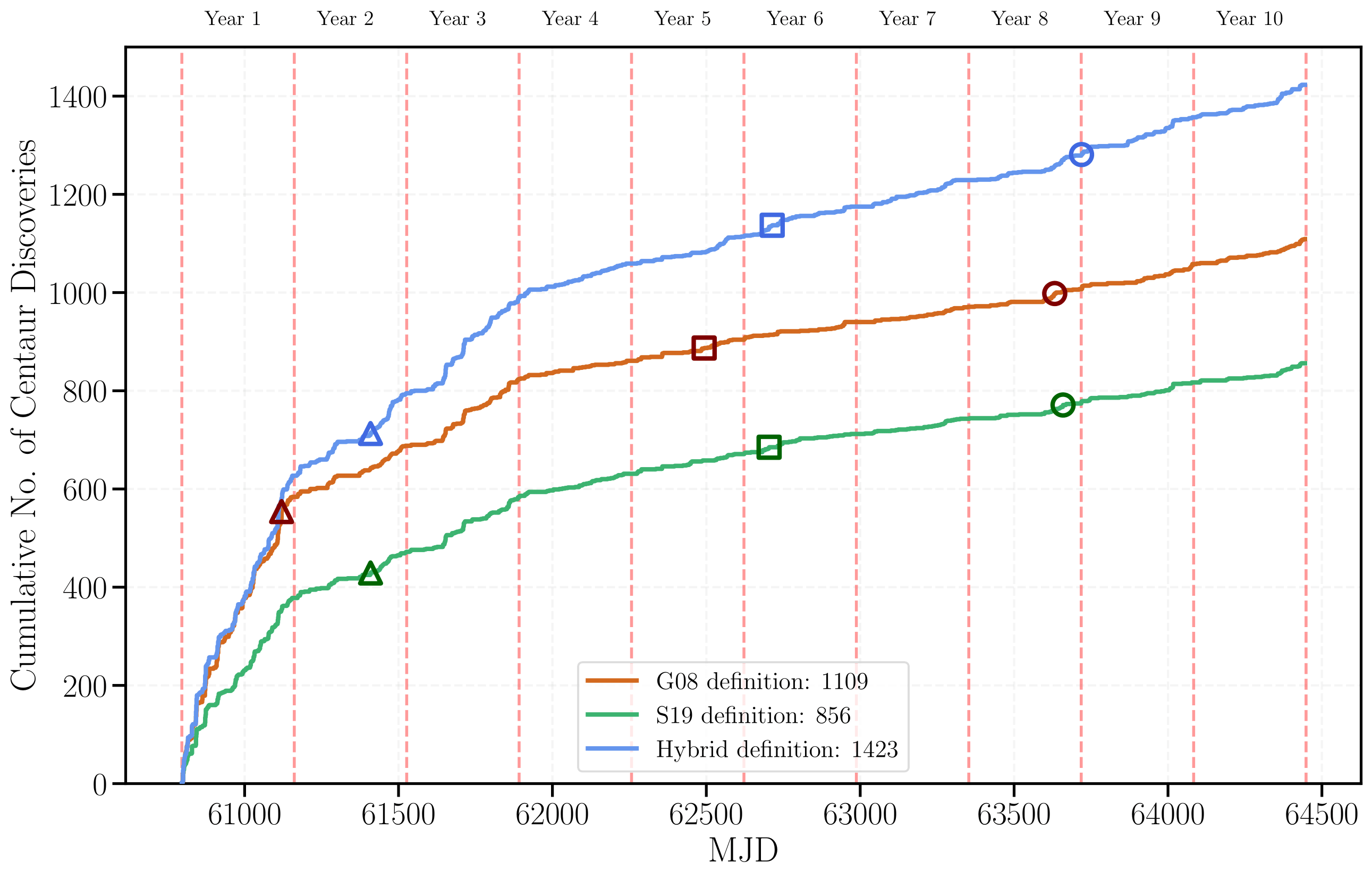 Cumulative histogram of the Centaur discoveries for the full 10 years of LSST operation for three different dynamical definitions. Overplotted are empty triangles, squares, and circles representing 50%, 80% and 90% completion marks respectively.
On the whole, this paper has shown the immense potential that the LSST is going to have for the Centaur population specifically. Expanding on every characterisation study in Centaur history by an order of magnitude, and giving large numbers of observations ripe for Centaur activity searches - and all of this can be begun to mined with only a year or two’s worth of LSST data! Now if only there was some postdoc ready to get on that…
Recommended citation: Murtagh, J., et al., Submitted, "Predictions of the LSST Solar System Yield: Discovery Rates and Characterizations of Centaurs", AJ